


For years, schema markup has been a useful part of SEO, although it hasn’t always been the highest-priority item. It can help search engines understand your content and make pages eligible for enhanced search results—but strong content, crawlability, and technical SEO still matter more.
Generative search gives marketers another reason to take structured information seriously. AI-powered search systems increasingly summarize businesses, compare options, and answer questions directly. Schema won’t guarantee that your content is selected or cited, but accurate structured data can reinforce what your pages communicate and reduce ambiguity about your organization, services, products, and expertise.
Let’s get you fluent enough to explain schema clearly, prioritize the implementations that matter, and evaluate the results without overstating what schema alone can accomplish.
Schema markup is structured data added to a web page. It gives search engines and AI systems additional context about what’s on the page.
Think of schema markup like adding labels to items in a pantry. A person can look around and probably identify most things, but labels such as “flour,” “sugar,” and “gluten-free” remove ambiguity and make everything faster to find and organize.
In the same way, search engines and AI systems can read a page without schema, but schema provides clear labels identifying information such as:
Your page still needs strong copy, clear headings, useful answers, internal links, and credible proof. Schema replaces none of that. It simply makes the information easier for machines to identify and interpret accurately.
For traditional SEO, schema helps search engines understand page content and can make a page eligible for certain enhanced search features. It also reinforces important relationships across your website: who owns the business, which services it offers, where it is located, and which pages answer specific questions.
For generative search, schema can help clarify entities and relationships. Who is the company? Who are the people behind it? What does the company do? What services does it offer? What topics does it have authority around? Which pages answer which questions?
Schema makes those connections clearer. It isn’t a magic switch that places your company in AI-generated answers, but it is one more way to make your website easier to interpret and summarize.
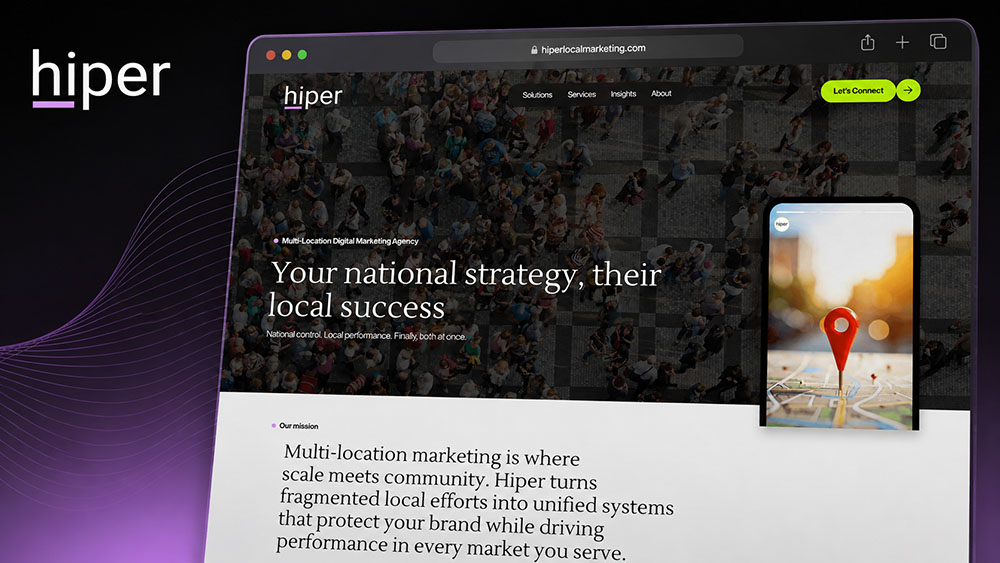 Our work for Hiper Local Marketing shows how stronger site structure can contribute to a broader SEO and GEO strategy. We rebuilt the company’s website on Webflow, improving its structure, semantic content, and overall discoverability. Following the launch, its engagement rate reached 45.1%, total users increased 11.6%, and engaged sessions increased 7.1%.
You don’t need to memorize every schema type to have a useful conversation about structured data. Most marketing teams can start with a few practical categories.
Global schema defines the overall entity behind a website. Common examples include Organization, LocalBusiness, ProfessionalService, WebSite, WebPage, Person, and BreadcrumbList.
Page-level schema describes a specific type of content. For a marketing website, that might include Article or BlogPosting for blog posts, Service for service pages, and FAQPage for question-and-answer content.
Other possibilities include Review, VideoObject, Product, Event, or HowTo, depending on what the site contains.
The rule of thumb is simple: schema should match what is actually visible on the page. A blog post should be marked up as a blog post. A product page should describe a real product. FAQPage schema should only represent questions and answers visitors can see on the page.
Some industries offer more specialized opportunities. Healthcare, legal services, education, events, employment, ecommerce, food, local services, and nonprofits all have schema types that can provide more precise context.
This is where marketers should ask a strategic question: What does a search engine or AI system need to understand about this business that it might not learn from a generic website structure?
FAQ schema is useful to understand because it connects directly to how people search. A strong FAQ section answers the questions customers ask before they are ready to contact a business.
Those questions can also clarify what the business knows, which problems it solves, and how it explains its services. The best FAQ content is genuinely helpful—not a place to recycle keywords or manufacture questions solely for search engines.
Schema can be difficult to measure because it is usually one part of a broader search strategy. However, there are practical ways to confirm it is implemented correctly and evaluate the larger results.
Use Google’s Rich Results Test and the Schema Markup Validator to confirm that the structured data is valid. Passing these tests does not guarantee improved rankings, but it confirms that machines can read the markup as intended.
Use Google Search Console to review structured data reports, search impressions, clicks, click-through rates, indexed pages, and landing-page performance.
Monitor schema alongside rankings, rich-result eligibility, and other technical and content improvements. Because these efforts often work together, avoid attributing every change in performance to schema alone.
For generative search, create a small set of prompts that reflect what potential customers might ask. These could include:
Run the prompts periodically and track whether the brand appears, whether the description is accurate, and which pages or sources appear to influence the response.
This still won’t isolate schema as the cause, but it can help you evaluate whether machines are developing a clearer and more accurate understanding of the business.
Schema is not a one-time task. When services, locations, team biographies, FAQs, or other page content change, review the corresponding structured data.
Stale schema creates confusion in the same way stale page copy does.
Schema helps machines interpret your content, but it cannot compensate for weak content.
Its value comes from accurately labeling useful, specific information about your business—not from adding more markup for its own sake. Start with the information that matters most to customers, make that information clear and credible on the page, and then use schema to describe it accurately.

